
A VOO calculator is a useful online tool for investors who want to estimate how an investment in the Vanguard S&P 500 ETF (VOO) could grow over time. By entering information such as your initial investment, monthly contributions, expected annual return, and investment period, you can create a projection of your potential portfolio value.
VOO is designed to track the S&P 500 Index, giving investors exposure to many large U.S. companies through a single exchange-traded fund. Because of its broad market exposure, VOO is commonly considered by investors who are interested in long-term U.S. stock-market investing.
A calculator does not predict the future or guarantee a specific return. Instead, it applies mathematical assumptions to show how your investment could potentially grow under different scenarios.
What Is a VOO Calculator?
A VOO calculator is an investment projection tool that estimates the potential future value of money invested in VOO. Depending on the calculator, you may be able to enter your starting investment, monthly or annual contributions, estimated annual return, investment period, and dividend reinvestment preferences.
For example, an investor could enter a $10,000 initial investment, contribute $500 each month, and select a hypothetical annual return of 8% for 20 years. The calculator would then estimate the potential portfolio value based on those assumptions.
The result is only an illustration. VOO’s actual performance can be different because stock-market returns fluctuate and are not guaranteed.
How Does a VOO Calculator Work?
A VOO calculator generally uses compound-growth mathematics to estimate how an investment may change over time. When an investment earns a return and those returns remain invested, future returns can potentially be earned on both the original investment and previous gains.
A basic compound-growth calculation can be represented as:
Future Value = P × (1 + r)ⁿ
Here, P represents the initial investment, r represents the assumed annual rate of return, and n represents the number of years.
When monthly contributions are included, the calculation becomes more detailed because each contribution has a different amount of time to potentially grow. Money invested earlier has more time in the market than money invested later.
This is why a VOO investment calculator can be helpful when comparing different contribution amounts and investment periods.
Why Use a VOO Investment Calculator?
A VOO investment calculator can help you understand how different investment assumptions affect potential long-term results. Instead of looking only at the current value of an investment, you can explore hypothetical outcomes over several years or decades.
You can use the calculator to compare different starting balances, monthly contributions, investment periods, and assumed rates of return. This can make the concept of compound growth easier to understand.
For example, you might compare investing $200 per month with investing $500 per month. You could also compare a 10-year investment period with a 20-year or 30-year period.
These comparisons can help demonstrate the mathematical impact of investing more money and remaining invested for longer periods.
VOO Calculator Example
Suppose an investor starts with $10,000 and contributes $500 every month for 20 years. If the calculator uses a hypothetical annual return of 8%, it can estimate the potential value of the portfolio at the end of the period.
The investor’s total contributions would be:
$10,000 + ($500 × 12 × 20) = $130,000
The difference between the total contributions and the calculator’s projected portfolio value would represent hypothetical investment growth.
This example does not mean that VOO will actually return 8% per year. Real investment returns vary from year to year, and the value of an equity investment can decline.
VOO Calculator With Monthly Contributions
Regular contributions are an important part of many long-term investment strategies. A calculator can show how recurring investments may accumulate over time.
For example, investing $300 per month for 25 years would result in total contributions of $90,000 before considering investment gains or losses.
A calculator can then apply a hypothetical rate of return to estimate how the portfolio might grow. Under favorable market conditions, the investment value could become higher than the amount contributed. Under unfavorable conditions, the portfolio could be worth less than the amount invested.
The longer the investment period, the more significant the mathematical effect of compounding can become. However, a longer investment period does not remove market risk.
VOO Dividend Calculator
A VOO dividend calculator can be used to estimate potential dividend income from an investment. The basic calculation uses the investment value and an assumed dividend yield.
For example, if an investment were hypothetically worth $50,000 and the assumed dividend yield were 1.5%, the estimated annual dividend would be:
$50,000 × 1.5% = $750
This is only an example. Actual dividend distributions can change, and dividend yield can change as the fund’s distributions and market price change.
Some investors choose to reinvest dividends instead of receiving them as cash. Reinvested dividends can purchase additional shares, which may then participate in future investment growth and potentially generate additional dividends.
VOO Calculator for Long-Term Investing
Time can have a significant effect on investment projections. A VOO calculator allows investors to compare hypothetical results over different periods, such as 10, 20, or 30 years.
A 10-year projection provides an illustration of how an investment could potentially develop over a decade. A 20-year projection gives contributions and potential returns more time to compound. A 30-year projection can demonstrate the mathematical effect of maintaining contributions over a very long period.
However, these calculations should not be interpreted as predictions. The stock market can experience periods of substantial gains and losses during any investment period.
What Is VOO?
VOO is the ticker symbol for the Vanguard S&P 500 ETF. The fund seeks to track the performance of the S&P 500 Index.
The S&P 500 represents a broad group of large U.S. companies across different sectors of the economy. Investing in VOO therefore provides exposure to many companies through one exchange-traded fund rather than requiring an investor to purchase each individual company separately.
Like other stock-market investments, VOO carries investment risk. Its market price can increase or decrease, and investors can lose money.
Investors should review Vanguard’s current fund information, including holdings, expenses, distributions, and risks, before making an investment decision.
Factors That Affect VOO Calculator Results
Several inputs can have a major effect on the result generated by a VOO calculator. The initial investment determines how much money is invested at the beginning of the projection. A larger initial investment can produce a larger projected value when the same assumptions are used.
Monthly contributions are another important factor. Increasing the amount invested regularly can significantly increase the total amount contributed over a long period.
The investment duration also matters. A longer period gives investments and contributions more time to potentially compound.
The assumed annual return can have an especially large effect on long-term projections. For this reason, it can be useful to test several different return assumptions rather than relying on one expected rate.
Dividend treatment can also affect the calculation. Reinvesting dividends may produce a different hypothetical result from taking dividends as cash.
Investment costs and taxes can also affect an investor’s actual outcome, depending on their circumstances.
Is a VOO Calculator Accurate?
A VOO calculator can accurately perform the mathematical calculation based on the assumptions entered, but its result should not be considered a prediction of actual future performance.
For example, if you enter an 8% annual return, the calculator can mathematically project what would happen if the investment achieved that assumed return. However, VOO will not necessarily earn exactly 8% each year.
Actual returns can vary because of economic conditions, corporate earnings, interest rates, inflation, market valuations, investor sentiment, and many other factors.
Therefore, calculator results are best viewed as hypothetical scenarios that help explain how investing mathematics works.
How to Use a VOO Calculator
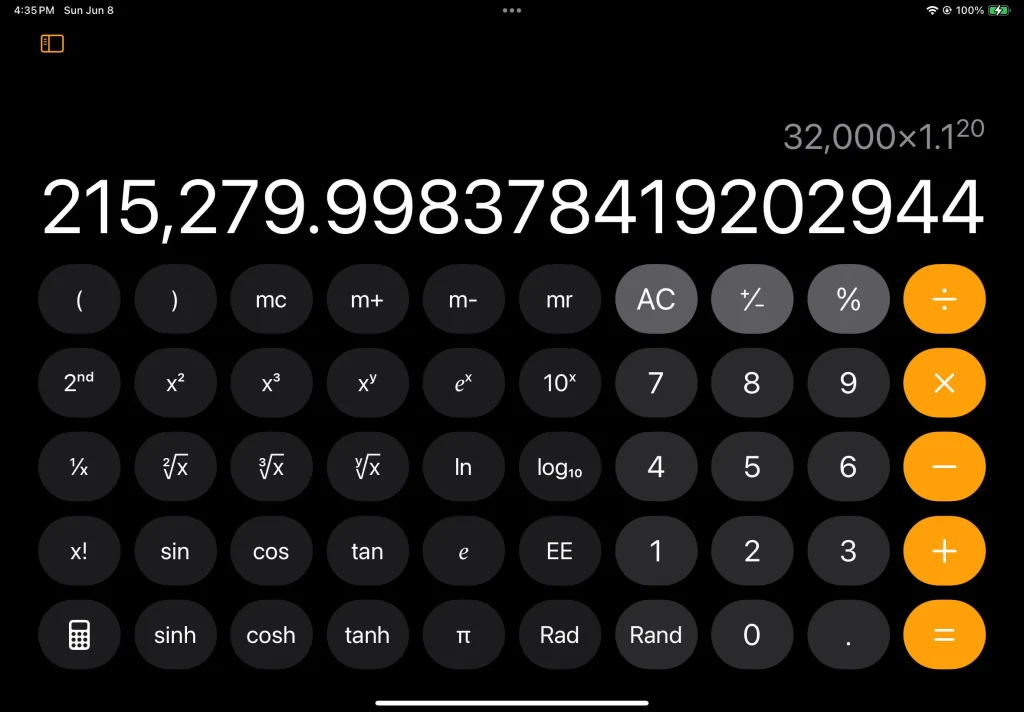
Using a VOO calculator is generally straightforward. Start by entering the amount you plan to invest initially. Next, enter your expected monthly or annual contribution.
Choose the number of years you plan to remain invested and enter a hypothetical annual return. If the calculator provides a dividend-reinvestment option, select the assumption that matches the scenario you want to examine.
After calculating the result, try changing one variable at a time. For example, increase the monthly contribution while keeping everything else the same. You can also compare different investment periods or return assumptions.
Testing multiple scenarios can provide a broader understanding of how your potential results depend on your assumptions.
VOO Calculator and Compound Growth
Compound growth is one of the main concepts behind long-term investment calculations. When returns remain invested, they can become part of the investment balance and potentially generate additional returns in the future.
For example, an investment that grows from $10,000 to $10,800 after a hypothetical 8% return has a new balance of $10,800. If the next year’s hypothetical return were also 8%, that return would be calculated on the new balance rather than only the original $10,000.
This simplified example demonstrates why the length of time an investment remains invested can have a substantial effect on mathematical projections.
Actual investment returns, however, do not normally occur at a fixed rate every year.
VOO Calculator vs. Individual Stock Investing
VOO provides exposure to a broad collection of large U.S. companies through an index-tracking ETF. Individual-stock investing involves purchasing shares of specific companies.
A VOO calculator can therefore be useful for investors who want to model a diversified S&P 500 investment rather than a single-company investment.
Diversification can reduce the impact that one company’s performance has on the overall portfolio, but it does not eliminate market risk. Because VOO is invested in stocks, its value can still fall substantially during market downturns.
Limitations of a VOO Calculator
There are several limitations to consider when using an investment calculator. The most important is that future market returns cannot be known with certainty.
A calculator may also use a constant annual return for simplicity, even though real-world investment returns fluctuate. Inflation can reduce the purchasing power of future money, while taxes and investment costs can reduce the amount an investor ultimately keeps.
Some calculators may also make different assumptions about when contributions occur, how dividends are treated, or how frequently returns compound.
For these reasons, calculator results should be treated as educational estimates rather than guaranteed outcomes.
Frequently Asked Questions About VOO Calculator
What is a VOO calculator?
A VOO calculator is a tool that estimates the potential future value of an investment in VOO using assumptions such as the initial investment, regular contributions, investment period, and expected annual return.
Can a VOO calculator predict future returns?
No. It can only create hypothetical projections based on the assumptions entered. Actual market performance may be significantly different.
Can I calculate VOO dividend income?
Yes. A dividend calculation can estimate potential income using an assumed investment value and dividend yield. Actual dividend payments can change over time.
Can a VOO calculator include monthly investments?
Many investment calculators allow you to include recurring monthly or annual contributions. This allows you to see how regular investing could affect a hypothetical future portfolio value.
Can I use a VOO calculator for retirement planning?
A VOO calculator can be one part of retirement planning, but it does not account for every factor. Retirement planning may also require consideration of inflation, taxes, withdrawals, expenses, other investments, and changes in market performance.
Is investing in VOO risk-free?
No. VOO is an equity investment and its value can rise or fall. Investors can lose money, including part or potentially all of their invested capital.
Final Thoughts on the VOO Calculator
A VOO calculator can be a useful educational tool for understanding how initial investments, recurring contributions, investment periods, and hypothetical returns interact.
Its purpose is not to guarantee how much money you will have in the future. Instead, it allows you to test different scenarios and understand the potential mathematical effects of long-term investing.
For a more useful projection, consider testing several return assumptions, contribution amounts, and investment periods. You can also compare scenarios where dividends are reinvested with scenarios where dividends are taken as cash.
Remember that VOO is a stock-market investment and future performance is uncertain. Before making an investment decision, consider your financial objectives, investment horizon, risk tolerance, taxes, fees, and overall financial circumstances.